Loading...
Know Your ICP: The Buyer Choice That Makes or Breaks Your Idea
by PreVibe Team
Ask a founder who their customer is, and you often hear "everyone", "parents", or "small businesses".
That answer feels safe. A bigger market sounds like a bigger chance to win. In practice, the opposite is true. A vague customer is one of the quietest ways to sink a good idea, because it makes every later choice harder.
This post explains what an ideal customer profile is, why a fuzzy one hurts you, and how to find a sharper one before you build.
What an ICP actually is
Your ideal customer profile, or ICP, is the specific buyer your product is built for. Not a broad group. One clear person with a budget, a habit, and a pain you can name.
"Parents" is not an ICP. It is tens of millions of people who want different things and can be reached in a hundred different ways.
"Parents who own a Yoto audio player and want screen-free bedtime content" is an ICP. You know who they are, where they gather, what they already pay for, and what they are missing. That is a group you can find, message, and serve.
A good ICP is narrow enough that you can answer three questions without guessing:
- Who exactly buys this, and do they hold the budget?
- What routine or moment do they already have that your product fits into?
- Where do you reach them, and what does that cost?
If the answer to any of these is "it depends", your ICP is still too wide.
Why a fuzzy ICP quietly kills ideas
A broad buyer does not fail loudly. It fails through four slow leaks that show up months later.
Your cost to acquire a customer climbs
When you sell to "everyone", you advertise to everyone. General ads and app-store discovery are crowded and expensive, so you pay a lot to reach people who may not care. A tight ICP lets you show up in the one place your buyer already visits, often for far less.
You have no clear channel
A sharp buyer comes with a built-in way to reach them: a subreddit, a professional group, a device community, a newsletter. A vague buyer has none. You end up spraying effort across many channels and getting thin results from each.
Your moat stays weak
If anyone could be your customer, anyone can be your competitor's too. Value that is easy to copy plus a buyer nobody owns is a recipe for a price war. Narrowing to one segment lets you build the trust, workflow, and reputation that a generalist cannot match.
Willingness to pay stays low
A broad audience will happily try a free product and then stop. A specific buyer with a real, recurring pain is far more likely to pay, because the product solves something they think about often.
Each leak on its own is survivable. Together they explain why so many "big market" ideas stall at a pile of free users and almost no revenue.
A case study: from broad app to sharp buyer
Here is how this plays out in a real PreVibe report. A founder validated a simple idea: a storytelling mobile app for kids.
The verdict came back PIVOT, 52 out of 100. Not a no, but not a green light either. The interesting part was why.
The report found genuine interest in personalized kids' stories. Several live products and indie launches proved parents will try them. But the scores exposed the real problem:
- Competition was crowded. The generic "AI bedtime stories" angle was full of similar-looking apps.
- The moat was weak. Story generation is easy to copy, so brand and trust were the only real defenses, and neither is easy to build fast.
- Paid conversion looked thin. Founder posts described thousands of downloads but only a handful of subscribers.
Every one of those weaknesses traces back to the same root: the buyer was "parents", a group too broad to own.
The opportunity map made the pattern easy to see. It listed more than 20 related products and, next to each, the exact buyer it targets.
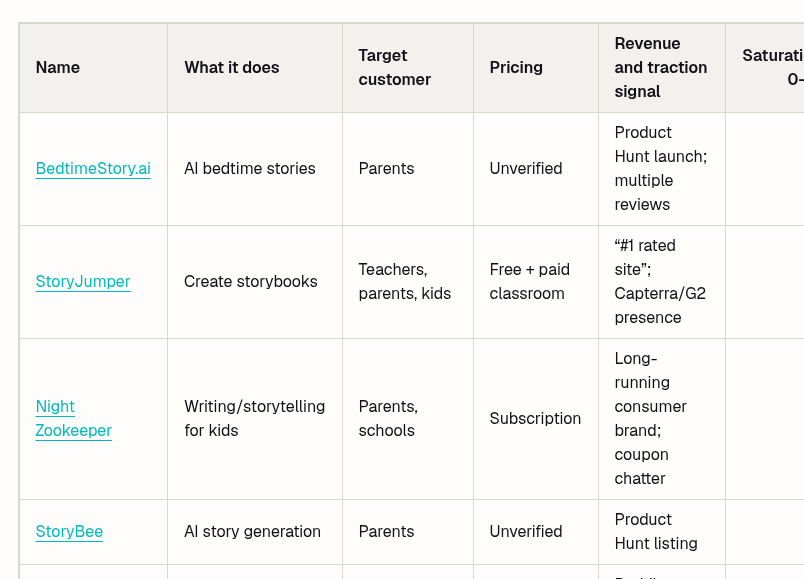
Read down the Target customer column. The commodity apps all point at the same broad "Parents". The products with a firmer footing point at someone narrower: teachers, schools, or a specific device community. That one column is the whole ICP lesson in miniature.
The fix was not a different product. It was a sharper ICP. The report's strongest paths kept the same core app and pointed it at one specific buyer each:
- Yoto families who want a personalized story sent straight to a player they already own. The buyer is clear, the habit exists, and there is a community to reach them in.
- Teachers and classrooms, where a school holds the budget, the tool fits a lesson, and usage repeats every week.
- Homeschool parents who value reading practice and comprehension, not just entertainment, so the product sells an outcome instead of a novelty.
Same idea. But each of these buyers has a budget, a routine, and a channel, so each one lowers acquisition cost, strengthens the habit, and gives the product something a generic app never had: a wedge.
That is the whole lesson in one report. The broad version scored a shaky 52. The narrow versions are where the real business lives.
How to find a better ICP
You do not need to guess your way to a sharper buyer. A few steps get you most of the way there.
Start from who already pays. Look at the products near your idea and notice which segments actually convert, not just which get downloads. If schools and families pay while casual consumers churn, that tells you where the money is.
Pick a buyer with a budget and a routine. The best ICPs already spend money on the problem and already have a habit your product can slot into. A device community, a classroom, a weekly ritual - each brings built-in demand.
Narrow until you can name the channel. Keep tightening the description of your buyer until you can point to the exact place you would reach them. If you cannot name that place, keep narrowing.
Check the pain is real and repeated. A one-time annoyance rarely supports a business. Look for a problem your buyer meets often enough to pay to remove.
The goal is not the smallest possible market. It is the smallest buyer that is still worth serving, because that is the one you can actually win first. You can expand later, from a position of strength.
How PreVibe helps you find the right buyer
Finding a sharper ICP is mostly a research problem, and that is exactly what PreVibe is built for.
- The opportunity map segments rivals by target customer. You see more than 20 related products with their pricing, traction signals, and who each one sells to, so you can spot which buyers already convert and which are commodity plays.
- The verdict scores the buyer you typed. Enter a broad idea and you tend to get a low score, on purpose. That is a signal to narrow. Enter a sharp buyer and the report tells you whether that specific bet holds up.
- Deep dives pressure-test one segment. Once you have a candidate ICP, you can dig into that single buyer, their acquisition cost, and the risks before you commit.
Your first research is free, so you can test a broad idea and a narrow one and watch the score move.
For more on turning research into a plan, read our guide to product research methods.
Read Next
5 Best Practices for Product Research
9 months ago
Maximize the value of your market research with these proven strategies for lean SaaS founders and entrepreneurs.
#best-practices#product-research#strategy
Bootstrapping vs Venture Funding: Which Is Right for You?
21 days ago
Bootstrapping means growing a startup on revenue and your own savings instead of investor money. Here is what it is, and why it often beats the venture path.
#bootstrapping#strategy#product-research
Product Research Methods: From Idea to PMF
9 months ago
Follow the proven sequence of research methods successful founders use to go from idea to product-market fit.
#product-research#strategy#tutorial